
Memory Lane
Lt
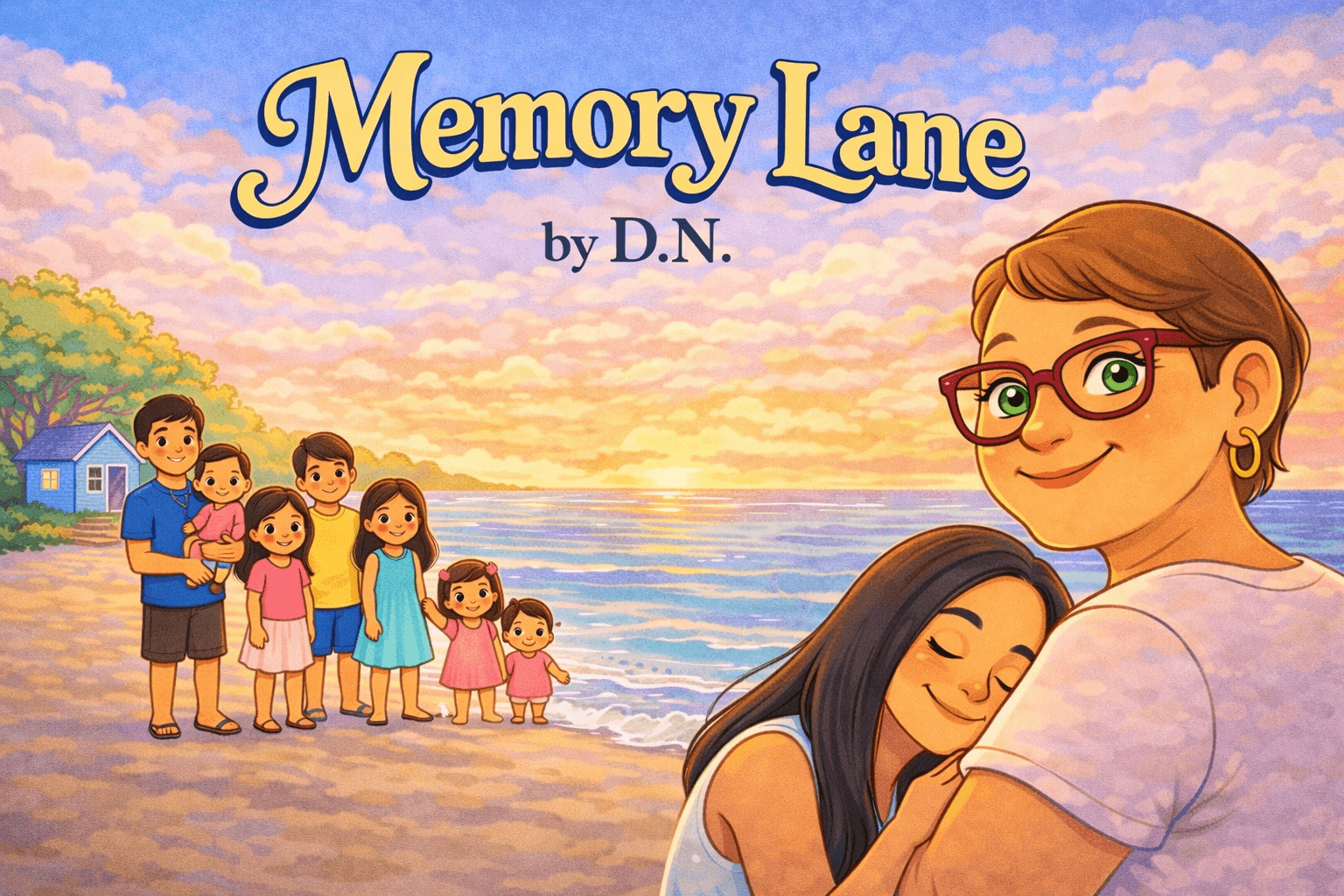
Memory Lane
by D.N.
There was a small gray-and-yellow house in Puerto Rico, standing quietly beneath a wide, open sky where clouds drifted slowly, as if they had all the time in the world.
The paint on the house had faded in places, softened by years of sun and salt in the air, telling quiet stories of time passing. A mango tree leaned gently over the yard, its branches generous and familiar, dropping leaves and fruit that crunched softly underfoot. The ground around it felt lived in, warm earth, scattered stones, and patches of grass that grew wherever they pleased.
The windows were almost always open. They welcomed the breeze as if it were an old friend, letting it carry in the sounds of everyday life: birds calling to one another, the faint rhythm of waves in the distance, and sometimes music drifting from a nearby radio, soft salsa, boleros, or a familiar tune hummed by someone passing by.
Behind the house, the mountains rose in the distance, steady and quiet, watching over everything. Palm trees swayed nearby, joined by guava trees, plantain plants, and all kinds of green that seemed to grow without asking permission. The neighborhood felt alive, wrapped in layers of movement and sound.
During the day, the air buzzed with life, birds singing, people talking, cars passing, the hum of the city always nearby but never overwhelming. At night, the sounds changed. Crickets filled the darkness, coquí frogs sang their familiar song, and dogs barked somewhere far away, their voices echoing softly through the warm air.
Here, the seasons never changed. It was always summer. Always warm. Always alive. A place where people were constantly moving, toward the beaches, the rivers, the food stands, the family gatherings always finding a reason to celebrate something, even when life wasn’t easy.
Puerto Rico was the place they called home. A place where they learned to face hardships with their heads held high. A place shaped by resilience, by laughter that survived storms, by joy that returned even after hard times came and went.
And in that small gray-and-yellow house lived Elena.
Elena became a mother when she was still very young. By the time she was in her early twenties, she had three children, two boys and one girl. Even then, Elena was strong in a quiet way. She was kind and friendly, always ready with a smile, and she had a sense of humor that filled any room she walked into.
Elena had a very particular laugh. It was loud and warm and impossible to ignore. Once she started laughing, everyone else usually did too, even if they didn’t know what the joke was yet. Her laughter made people feel happy, like everything might be okay after all.
Elena’s own childhood had not always been easy. There were times when life felt heavy and unfair. But instead of letting that hard past shape her future, Elena chose something different. She worked hard, stayed hopeful, and promised herself that her children would have a better life than the one she had known.
One thing Elena loved very much was airplanes. She loved watching them rise into the sky and disappear into the clouds. To her, airplanes meant movement, possibility, and new beginnings. That love became her job. Elena worked with airplanes every day, and she was very good at it. She was the only woman in her department, but she didn’t let that stop her. She earned awards for her work, and her coworkers respected her. Elena was everyone’s friend, the kind of person who helped, listened, and laughed with others.
Elena had bright green eyes that sparkled when she smiled. People often talked about how beautiful she was, but what stayed with them most was her warmth and kindness.
Because Elena worked long hours, her children often stayed with their grandparents. Elena missed her children deeply. Some days, she wished she could be in two places at once, at work and at home. Even when she was tired, she reminded herself why she worked so hard. Thinking of her children made her feel proud and strong.
When Elena was home, she made every moment count. She loved pulling playful pranks on her kids, hiding behind doors to surprise them, switching voices, or pretending she had forgotten something important just to make them laugh. The house was often filled with giggles, shouts, and her contagious laugh echoing through the rooms.
The children grew up with days full of adventure. They rode bikes with their neighbors, played outside until the sun began to set, and explored creeks, rivers, and beaches across the island. Sometimes they were together, sometimes with friends, and sometimes with their grandparents nearby. Their childhood felt free, bright, and full of stories.
Elena loved telling family stories again and again. She told them at the table, in the living room, and during family visits. Even if everyone had heard the story before, Elena laughed every time as if it were brand new. Her children and grandchildren learned that some stories weren’t meant to be told just once, they were meant to be shared over and over.
As the years passed, the children grew older and began lives of their own. The house slowly grew quieter until it was just Elena and her husband. But the quiet never lasted for long.
Soon, visits became louder again. Little feet ran through the house. Laughter returned. Before Elena even realized how it happened, she had seven grandchildren. She adored them, played with them, teased them gently, and filled their days with love and stories.
Elena had lived a life full of work, laughter, and sacrifice. She had loved deeply and given everything she could. And surrounded by her family and her memories, her story continued.
As time went on, Elena’s daughter moved away. Even so, they stayed close. They talked almost every day, sometimes on the phone, and often on FaceTime. Many of those calls happened while Elena was at work. Her daughter would watch her on the screen, smiling as Elena talked and laughed, with airplanes moving behind her, coming and going, rising into the sky and disappearing into the clouds.
When her daughter visited, she brought her child along. Those visits were special. Together, they took Elena on little adventures whenever she could take time off work. They shared meals, went for drives, and laughed over old stories, making new memories along the way.
Elena’s sons and their families visited often too. The house filled with voices and footsteps again. But after everyone left, the quiet returned.
Since the children had moved away, things felt different. There were days when Elena felt lonely. Sometimes she wished she had been home more when her children were young. Those thoughts were heavy and sweet at the same time. Still, she felt proud, very proud of the men and woman she had raised.
During visits and long conversations, Elena’s daughter began to notice small things. Nothing big at first. Just little moments that felt new. A question asked twice. Something misplaced. A pause where there hadn’t been one before.
It made her daughter pause too, even though she didn’t understand why yet.
Elena was still herself, loving, funny, and warm. Her laugh still filled the room. Her stories still came with smiles. But something was changing.
As time went on, Camila began to notice more little changes in her mom.
At first, she tried to ignore them. Everyone forgets things sometimes, she told herself. But the moments kept adding up. Elena would ask the same question again and again, sometimes only minutes apart. She forgot plans they had just talked about or important dates she used to remember easily.
Camila asked her dad if he noticed anything different. She asked her brothers too.
They didn’t agree.
“You’re being dramatic,” they said.
“There’s nothing wrong with Mom.”
Camila wanted to believe them. But something inside her didn’t let go.
So Camila made a decision.
Instead of bringing her mom on just one visit, she began inviting Elena to travel with her whenever she could. She thought that spending more time together might help her understand what was happening.
At first, everything felt normal. They laughed, shared meals, and talked the way they always had. Elena told stories and laughed her contagious laugh.
But slowly, things felt different.
Elena repeated questions she had just asked. She forgot where they were going, even after being told. She struggled to follow conversations and sometimes lost her words. She mixed memories together, telling stories that didn’t quite make sense.
Sometimes Elena talked as if she were living in another time. Other times, she became quiet and secretive, holding onto thoughts she couldn’t explain. Her moods shifted too. She became anxious and fearful without knowing why.
Camila noticed that even when her mom forgot details, she still remembered feelings. She still felt comfort when Camila was near. She still laughed when Camila laughed.
Each trip showed Camila a little more.
After one of those visits, Elena returned to Puerto Rico.
Not long after, there was an accident at work.
Elena didn’t talk about it.
Then there was another accident.
Still, she said nothing.
After the third accident at work, Elena was sent to see a doctor.
The doctor explained things slowly.
Some words stayed.
Others didn’t.
Elena heard that something was wrong with her brain.
She didn’t feel sick.
She didn’t feel broken.
She felt like herself.
That was when the family began to hear words that matched what Camila had been noticing all along.
Life changed slowly
and then all at once.
When Elena lost her job, her days changed completely.
She woke up early, the way she always had, and then realized there was nowhere she needed to be. Sometimes she stood in the kitchen, unsure of what she had planned to do next. Time felt slower. Quieter.
Some mornings, she believed she still had to get ready for work. Other mornings, she felt sad without knowing why. She missed feeling useful. She missed knowing exactly what came next.
For Elena, life began to feel confusing in ways she couldn’t explain.
Some days, she felt normal. Other days, her thoughts felt slippery, like trying to hold water in her hands. She knew what she wanted to say, but the words didn’t always come out right. Sometimes they disappeared before she could catch them. When that happened, Elena laughed it off, but inside she felt embarrassed and uneasy.
There were moments when Elena knew something was wrong.
Those moments scared her.
Other times, the feeling disappeared, and she couldn’t understand why everyone else seemed worried. That knowing came and went, like a light flickering on and off.
She started noticing Camila watching her more closely.
Not in a mean way.
In a careful way.
Elena felt it, even if she didn’t understand it. Sometimes Camila spoke a little slower. Sometimes she repeated things gently. Elena didn’t like that feeling. It made her worry that something about her was changing, even though she didn’t know how to explain it.
Through it all, Elena still felt love.
She felt comfort when Camila was near. She felt calm when voices were gentle. Even when her thoughts felt tangled, her heart recognized safety.
One night, after a hard visit, Camila sat alone in her car and cried.
The house behind her was quiet.
The sky above her was full of stars.
She remembered something the doctor had said:
She may not remember facts… but she will remember how she feels.
That’s when Camila had an idea.
If her mother couldn’t hold onto every detail, she would make moments worth living anyway.
Camila packed the car.
Some days, she buckled children into their seats, little shoes kicking, backpacks thumping against doors, laughter bouncing off the windows. Someone always forgot something and had to run back inside. Other days, it was just Elena, Camila, and Abuela riding together like they had long ago, their voices softer, their conversations slower, the silence comfortable instead of heavy. And sometimes, it was only Camila and her mother, the road stretching quietly ahead of them, the hum of tires filling the space between words.
She helped Elena into the passenger seat and handed her a small bag of snacks.
“Where are we going?” Elena asked.
Camila smiled.
“On a road trip, Mamá.”
Elena laughed softly. “Where to?”
Camila took a breath.
“Memory Lane.”
Elena nodded, amused. “Alright then.”
They drove through Old San Juan, where the streets were made of shiny blue stones that glimmered under the sun and caught the light after rain. The buildings stood close together, painted in soft yellows, pinks, blues and greens. Balconies overflowed with plants and hanging laundry. Music spilled out of open windows, guitars, voices singing, someone laughing mid-song. Vendors called out from corners, greeting people like old friends. A breeze carried the smell of coffee and fried food.
Between narrow streets, the ocean appeared suddenly, bright, endless, then disappeared again as the road turned.
Elena leaned toward the window.
“I know this place,” she said slowly. “I just… can’t remember what it’s called.”
“That’s okay,” Camila replied. “You’ve been here before.”
Elena nodded. “I know how to get around it. My feet remember.”
They walked near the great stone walls by the ocean, where the grass stretched wide and green and the wind rushed freely, tugging at their clothes and hair. Children ran past them, flying kites that dipped and soared, the strings pulling hard as the wind lifted them higher. Elena stood still, watching, her face tilted toward the sky.
“They look like they’re playing,” she said.
“They are,” Camila answered.
Inside the thick stone passages, the air felt cooler. Their footsteps echoed softly, each step answering the last. Elena traced her fingers along the warm walls, following the curves and edges, stopping just before a turn.
“It twists here,” she said. “And then it opens.”
She was right.
They stepped into open space where the city spread below them, rooftops, streets, tiny moving cars. Elena laughed quietly.
“It looks smaller from up here.”
Nearby, in a small park, pigeons burst into the air all at once, wings fluttering, feathers flashing in the sunlight. Elena startled, then laughed, lifting her hands as the birds circled and settled again.
“Well!” she said. “They’re busy.”
One pigeon stayed behind, tilting its head near her feet. Elena crouched slowly, smiling.
“You again,” she said, as if greeting something familiar.
They wandered down narrow streets lined with bright doors and painted walls. Music floated through the air. People leaned out of windows to talk to neighbors below. Elena stopped often, not because she was lost, but because something caught her eye.
“I don’t know why I like this one,” she said, pointing at a balcony heavy with plants. “But I do.”
Camila didn’t rush her.
On another trip, they followed winding roads into the mountains. The road curved and climbed, green hills rising on every side, folding into one another like waves made of land. Mist drifted through the trees and brushed against the car windows. The air grew cooler and smelled rich, wet earth, leaves, coffee.
Abuela hummed softly in the back seat, an old tune that seemed to belong to the mountains themselves.
Elena closed her eyes.
She didn’t talk about childhood.
She hardly ever did.
Instead, she focused on the present, the road, the trees, the gentle rhythm of the drive, and the familiar songs playing on the radio.
“Left here,” she said suddenly.
Camila followed.
“I couldn’t tell you the name of this town,” Elena added, “but I know this road.”
They passed small towns where people waved from porches and radios played softly from open doors. Life moved slower here.
Elena watched carefully.
“People still sit outside,” she said. “That hasn’t changed.”
Some trips were short.
Some were longer.
Some days were full, and other days were quiet.
They didn’t go everywhere at once.
Sometimes Camila arrived late in the evening, unpacked her bag, and the first night was spent sitting at the kitchen table, talking softly while the house settled around them. Elena moved slower on those days, still adjusting to the rhythm of having her daughter near again. Other times, the first day passed quietly, laundry folded, coffee reheated, the television murmuring in the background while they rested side by side.
And some mornings, after breakfast and a slow start, Elena would look up and say,
“Let’s go.”
On one of those mornings, they drove toward the mountains.
The road narrowed as they climbed, the lines on the pavement fading, the turns coming closer together. Houses thinned out. The air grew cooler with every curve. The city slowly slipped behind them, replaced by tall trees, mist clinging to branches, and the steady rhythm of tires moving forward.
Elena watched the road closely, her eyes following each bend as if she had traveled it many times before.
“This way,” she said once, lifting her hand slightly.
Camila didn’t hesitate. She turned where Elena pointed.
The forest greeted them before they even stepped out of the car.
In El Yunque, rain tapped gently on leaves, soft but steady, like a quiet conversation happening all around them. Frogs sang from hidden places. The air smelled clean and damp, filled with earth and green. The forest felt thick and alive, layered with greens so deep they almost looked blue. Sunlight slipped through the trees like golden ribbons, warming patches of ground before disappearing again.
They didn’t hurry.
They walked slowly, stopping when Elena stopped. Sometimes that was because a leaf caught her attention or because the sound of water grew louder, or simply because the forest asked them to pause.
Elena reached out and touched the leaves as she passed, her fingers brushing their edges, feeling the smoothness, the ridges, the tiny drops of water clinging to them.
“I’ve walked here before,” she said.
“I don’t remember when. But my body knows.”
Camila nodded and stayed beside her, matching her pace, letting the path unfold one step at a time.
On another day, after a different arrival, they returned to the mountains again, this time stopping by the waterfall.
They could hear it before they saw it.
Water rushed fast over smooth stone, tumbling down in white ribbons, the sound strong and steady. Mist rose into the air, cooling their faces, dampening their hair. The noise filled everything, leaving no space for thoughts or plans, only standing, only listening.
Elena didn’t speak at first. She stood watching, quiet and still.
Then she said,
“It keeps moving.”
She paused.
“Even when you don’t.”
They stayed only a short while.
They didn’t need more than that.
Another trip brought them to the river.
This time, the grandchildren came too. The car felt different, louder, crowded with questions and excitement. Someone asked how much longer. Someone else sang along to the music. Shoes were kicked off as soon as they reached the water’s edge.
Clear water rushed over smooth stones, sparkling in the sunlight. Laughter bounced between the trees as the children splashed and slipped and tried to balance on rocks.
One of them lost their footing and splashed down hard.
Elena laughed, startled and delighted.
“Oh!” she said, clapping once.
She rolled up her pants and stepped closer to the edge, lowering her toes into the water.
Cold.
She pulled back and laughed again, shaking her head.
Then she tried once more.
“What’s your name again?” she asked gently, smiling at the child.
The child answered.
Elena repeated it once, carefully, like she was placing it somewhere safe and fragile.
On another visit, on a different day entirely, they went somewhere full of life.
At Ojo de Agua, voices filled the air. Children ran past in bursts of laughter. Music played nearby, vendors called out and the smell of food drifted from the restaurants lining the paths. The place moved with energy, layered with history, sound, and the everyday rhythm of Puerto Rican life.
And in the middle of it all, the spring waited.
The water was clear and shockingly cold, the kind that stole your breath for a moment before your body learned to accept it. It stayed steady and untouched by the noise around it, holding its temperature and its stillness no matter how loud the world became.
Elena slipped into the water slowly, then floated, eyes open. The cold wrapped around her, sharp at first, then grounding. It pulled her fully into the present, quieting her thoughts in a way warmth never could. Sunlight shimmered across the surface, breaking into quick flashes of light that moved as she breathed.
Camila sat on the edge, her feet dangling just above the water, watching the ripples spread and slowly fade. The sounds around them continued, voices, music, laughter, but here, in this small space, time seemed to loosen its grip.
Elena floated nearby for a moment longer, then lifted her head.
“I know this place,” she said.
“I came here with my family as a kid. It’s changed a lot.”
Camila looked at her and smiled, the kind of smile that says I’m here with you. They took pictures and short videos, small pieces of the day they wanted to keep, knowing that remembering sometimes mattered as much as the moment itself.
There were beach days too.
Some with children racing ahead, their laughter carried by the wind. Some with only the two of them walking slowly along the shore, leaving footprints that the waves erased behind them. Palm trees lined the sand. Music drifted through the air from nearby kiosks. The smell of food mixed with salt and sun.
Elena stepped into the water slowly, steady and sure. When the waves reached her ankles, she laughed, surprised every time.
Her laugh, warm and full, rose above the sound of the sea.
Between these places were long drives.
Sometimes they drove for hours. The roads curved along the coast, dipped suddenly, climbed through mountains, then straightened again. Sometimes the radio played softly. Sometimes it was turned off. Windows stayed down, wind moving through the car.
Sometimes they talked about small things.
Sometimes they sat in silence.
Elena asked questions.
Camila answered.
Sometimes Elena asked the same question again, not because she didn’t care, but because the order of things slipped.
Camila answered again.
Because Elena was still Elena.
She remembered how to be there.
She remembered how to feel safe.
She remembered how to laugh.
And slowly, trip by trip, mile by mile, arrival after arrival, Camila learned that loving her mother now meant trusting what still worked,
and letting the rest unfold in its own time.
Everything Camila did became an act of love.
Love practiced with patience.
Love shaped by understanding.
Love that waited when it was easier to rush.
Love that stayed when it would have been easier to step away.
Because love is patient.
Love is kind.
And sometimes love hurts
but it is still yours.
Camila learned to cherish her mother not only in the good moments, but in the quiet ones too. She learned to honor her while there was still time. Not by fixing what could not be fixed, but by building moments, small, ordinary, meaningful moments, that could be held close later.
She remembered the things her mother used to say when she was little.
Be kind.
Dream big.
Chase your dreams so you never leave this world with regret.
Do better than me.
Be better than me.
When Camila was a child, she never fully understood those words. They sounded like advice meant for the future, far away and distant.
Now, she understood.
Days became months.
Months became years.
Elena spoke less.
She forgot more.
But some things never left her.
She never stopped responding to music.
To touch.
To laughter.
To love.
Her eyes still softened when Camila held her hand.
Her body still leaned toward warmth and gentleness.
Her presence still met love when love was offered.
And that mattered.
One quiet morning, Elena passed away.
There was no rush.
No loud moment.
Just stillness.
After that, the blue house felt different.
The rooms were quieter.
The air heavier.
But it was not empty.
Because Memory Lane was still alive.
It lived in the roads they traveled together.
In the places they visited again and again.
In the laughter that once filled the car.
In the feeling of a hand held patiently.
It lived in Camila.
If someone you love has dementia,
their world may not look like yours,
They may forget names, places, and time.
But they still feel love, comfort, fear, and joy.
Sometimes the memories we try to save for them
become the stories that carry us forward.
Love does not disappear when memory fades.
It changes shape —
and stays.